

Prairie fires play an important role in maintaining healthy prairie ecosystems. Periodic fire helps rejuvenate native grass, tree and shrub vegetation by removing accumulated plant litter and accelerating the natural decomposition process. Many native prairie grasses, forbs, and shrubs are well adapted to fire and often respond with vigorous growth following a burn. Fire also contributes to nutrient cycling by returning organic matter and minerals to the soil, which supports the continued productivity of prairie landscapes.
Despite many ecological benefits, prairie fires can also pose significant risks. When uncontrolled, they can become highly destructive, threatening homes, agricultural operations, livestock, infrastructure, and community safety.
The role of trees and shrub in prairie fire
Either naturally occurring bluffs of trees or planted windbreaks and shelterbelts trees provides many valuable functions in agricultural and rural landscapes. One of trees roles is helping to slow the spread and intensity of fast-moving prairie fire. In many cases, natural forest, shelterbelts can act as strategic buffers that help protect farmyards, livestock areas, buildings, and other infrastructure from rapidly spreading prairie fires. Trees act as natural water storage tanks in the landscape. Their roots absorb and store water from the soil, while trunks, branches, and leaves hold significant moisture within their tissues(up to 50 % of tree is water). Trees and forest also higher soil moisture, keep snow longer and keep air moisture longer compared to open grass prairie, which can help reduce fire speed and intensity.
Trees and shrubs generally take much longer to ignite and burn than native grasses. Native prairie grasses are fine, dry fuels that can ignite almost instantly and allow fires to spread rapidly across open landscapes. In contrast, trees and shrubs contain more moisture and denser plant tissues, which slow the ignition process and reduce the speed at which fire spreads. As a result, woody vegetation such as shelterbelts and windbreaks can help slow advancing prairie fires and provide valuable time for fire suppression efforts.
Fire prevention in shelterbelts
Fires can start around farmyards for a variety of reasons—including machinery sparks, electrical issues, controlled burns that escape, or dry vegetation—and may quickly spread into nearby shelterbelts. Prairie fires can spread rapidly under dry and windy conditions, making them difficult to contain and increasing the potential for widespread damage. Proactive fire prevention and maintenance practices are essential to reduce these risks. Several management practices can help reduce fire hazards within shelterbelts:
• Prune lower dead branches on trees and remove interior deadwood, as these materials can ignite easily and allow fire to spread upward.
• Prune tree branches up to approximately two metres from the ground in yard areas to reduce “ladder fuels” that allow ground fires to reach the canopy.
• In older shrub rows, remove dead stems individually or cut the entire row back to encourage rejuvenation through root suckering.
• Avoid pruning trees or shrubs during periods of strong winds or very low air humidity.
• Avoid using power tools such as chainsaws during extremely dry conditions, as sparks may ignite surrounding vegetation.
• When possible, use hand tools such as pruners, loppers, and handsaws to perform pruning tasks.
• Contact your utility provider to safely remove branches or tree tops that are close to powerlines.
• Remove woody debris, fallen branches, and other combustible materials from the ground.
• Avoid planting highly flammable tree and shrub species near houses, barns, or other building
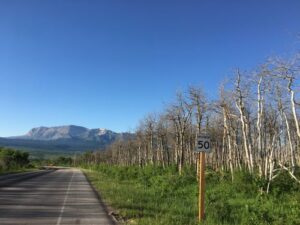
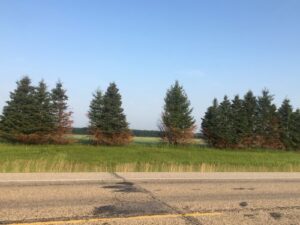
Rejuvenation of trees and shrubs after fire
The width and density of a shelterbelt significantly influence its effectiveness as a fire barrier. Wider shelterbelts with multiple rows of trees and shrubs generally provide greater protection by creating a broader zone where fire intensity may be reduced. Depending on the intensity of the fire and the degree of damage, many trees and shrubs may recover naturally. Some species are well adapted to fire and can regenerate quickly, while others may require replanting.
Tree rejuvenation
Tree regeneration after fire depends on the species and the severity of the damage. Some species recover naturally, while others must be replanted to restore shelterbelt function. Most coniferous trees, with the exception of many pine species, do not regenerate easily after fire and often require replanting. In contrast, many deciduous hardwood species are more resistant to fire due to their higher internal moisture content. Burned trees that remain structurally sound may be salvaged and used as firewood. When cutting charred wood, exercise caution because fine burned dust and particles may be hazardous to inhale.
Pines commonly regenerate after fire. Heat from flames causes pine cones to open and release seeds that were previously sealed within the cones. These seeds fall onto nutrient-rich soil created by the fire and may germinate quickly. Pine bark can also tolerate limited fire damage, allowing some trees to survive and continue growing.
Spruce trees are less well adapted to post-fire regeneration. Fires of almost any intensity may kill spruce trees, including their cones and seeds. Natural regeneration generally occurs only when nearby living trees produce seeds that disperse into the burned area. Because spruce trees produce significant seed crops only every four to eight years, natural recovery can be slow. If all spruce trees in a shelterbelt are destroyed, replanting is usually necessary to restore the windbreak.
Cottonwood, hybrid poplar, aspen, and willow species possess extensive root systems and commonly regenerate through vigorous suckering after fire. Following a burn, thousands of young shoots may emerge from surviving roots.
Manitoba maple reproduces readily through both seeds and root suckers. It can establish naturally under a wide range of conditions, including on moist soils following fire disturbance. Even if the entire tree is burned, the root system may produce numerous suckers that quickly regenerate the stand.
Ash species (green and black ash) are also prolific seed producers. Their seeds may remain viable in the soil for three to four years. Unlike some other hardwoods, ash typically regenerates from seed rather than through root suckering.Elm trees, particularly American elm, are relatively fire resistant due to their thick bark. American elm produces abundant seeds that allow natural regeneration in favourable conditions. However, if the entire tree is severely damaged or destroyed by fire, replanting may be necessary
Shrub rejuvenation
Many shrubs regenerate after fire through root suckering or seed production. The success of natural regeneration largely depends on the extent of damage to stems and root systems. If stems are only lightly damaged, new leaves and growth may appear shortly after the fire.
Caragana is a hardy non-native shrub that is moderately to high a fire prone. It regenerates through both seed production and underground rhizomes. Caragana produces abundant seeds that can remain viable in the soil for many years. When conditions become favourable, these seeds germinate and establish new plants. Its extensive root system also encourages vigorous suckering. As a nitrogen-fixing legume, caragana can help restore nitrogen levels in the soil following a fire.
Lilac is another hardy non-native shrub that typically regenerates through root suckering. Its root system is dense but relatively shallow. Cutting damaged stems to approximately 15 cm (six inches) above ground level can stimulate new shoots from the root system. If suckering does not occur, replanting may be required.
Sea buckthorn is also a hardy non-native shrub that regenerates vigorously through suckering and can recover rapidly following fire disturbance.
While trees cannot stop prairie fires, properly maintained shelterbelts and windbreaks as well as natural tree bluffs can significantly slow prairie fire spread and intensity while providing firefighters with valuable time to respond. For these reasons, natural trees, windbreaks and shelterbelts remain an important component of fire prevention and landscape resilience across the prairie regions.
Resources
FireSmart Alberta provides excellent resources for landowners, farmers, homeowners, communities, and other land users. All land users are strongly encouraged to use these resources as part of their home, farm, and community planning and implementation.